Engines
This guide will give you everything you need to know in order to be able to choose which engines you will use on your rockets. The three main things this guide will cover are
- Isp (efficiency)
- Gimballing (control)
- Thrust (power)
1. Isp
There are two main categories for engines in KSP. These are:
- Vacuum Optimized
- Atmosphere/Sea Level Optimized
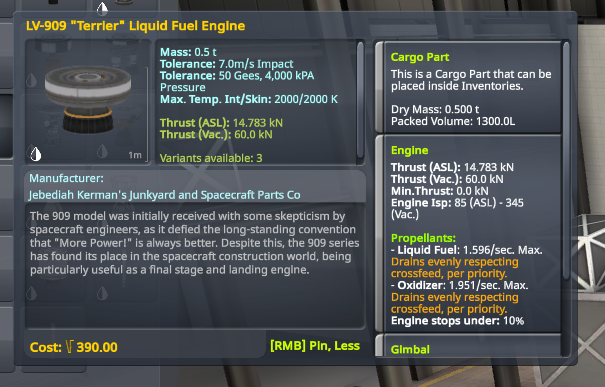
The way that you can tell what an engine is optimized for is by it's ISP. The larger the Isp, the longer it takes to burn your fuel. The smaller the Isp, the quicker fuel burns. This doesn't effect the engines strength though, so you always want the highest possible Isp.
See the picture above, where it says Engine Isp: 85 (ASL) - 345 (Vac.)
This is an engine optimized for vacuum use. The engine in this picture lasts 4 times longer in a vacuum, so you would want to use this once you escape Kerbin's atmosphere. You can see that because it has a vacuum Isp of 345, and an atmospheric Isp of 85. (roughly 4x less than 345)
If you do use it in the atmosphere, just expect to run out of fuel 4 times faster.
2. Gimballing
This is probably the most straightforward attribute of an engine, because even though there are different "levels" of gimballing, in most cases you can treat it as "it does or doesn't have it"
Gimballing simply means that when you control a rocket, the engine will actually turn and point in a direction that helps turn the rocket where you're trying to go. No wings or any other control systems necessary. This does only help when the engine is on of course, but because of this, your ascent stage can often be simplified to only being controlled through gimballing.
This allows you to avoid placing wings, which can improve efficiency since they add drag. But they can still be useful for stability, especially in the lower atmosphere or on less stable rockets. So if you're struggling to control your rocket you can consider wings, but gimballing is often enough.
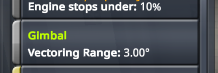
You can check if an engine has gimballing in it's detail pane
This engine has a vectoring range of 3 degrees, so the engine can gimbal to point 3 degrees in any direction. Some have more range, some have less. But this vectoring range attribute is how you see if an engine can gimbal or not.
3. Thrust - TWR
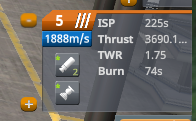
The last thing you need to know about the basics of engines is thrust. You don't really need to know the specific thrust of an engine. You'll at most just compare "does this one have more or less thrust?" The thing that really matters, is your TWR - thrust to weight ratio.
To see your TWR for a given stage, just click on that stage in the rocket builder.
In general, for launch you want about 1.3 to 1.6 TWR. Higher than that is often too aggressive, and difficult to use as efficiently.
In orbit, you have more leeway since you're not fighting gravity as much, and you're not fighting the atmosphere. You still don't want to be moving abysmally slow though. A good range is anywhere between 0.7 and 1.2.
When making a mun lander, you'll probably be most comfortable with around 1.5+ TWR. The less time you're fighting gravity the better, but if you are sitting at 1.1 TWR and increasing it is difficult, you will be fine.
TWR is affected by gravity
The last note about TWR is that because your weight changes based on gravity, gravity changes DO change your TWR as well. If your mun lander stage has about .2 TWR on the launch pad, you'll end up with about 1.2 TWR on the mun. So when you're planning your landing stage, take into account the gravity on the planet or moon you're going to be landing on - your TWR probably doesn't need to be 1.5 right from Kerbin's launch pad.
Comments
Loading comments...